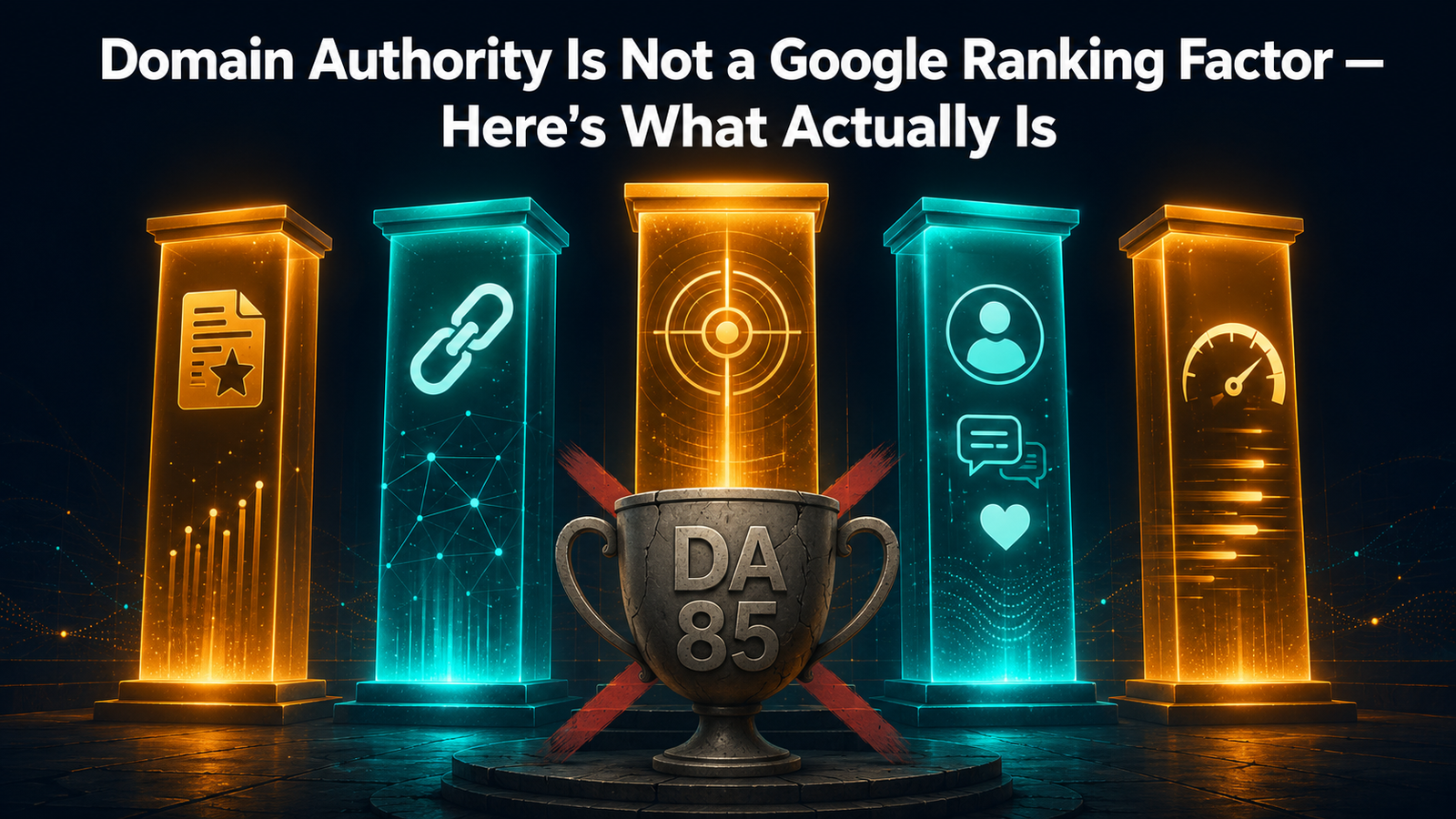
If you are checking your website's Domain Authority score, comparing it to competitors, and making strategic decisions based on that number — you are optimising for a metric that Google has repeatedly confirmed it does not use. Domain Authority is a Moz product. It is useful as a comparative proxy. But it is not a Google ranking factor, and improving your DA does not directly improve your rankings. Here is what Google actually uses — and how to focus your energy on the right things.
Domain Authority is perhaps the most misunderstood metric in SEO. It appears in nearly every SEO tool. Clients ask about it in almost every onboarding meeting. Agency reports lead with it. Link building campaigns are evaluated by it. And yet Google's own engineers have stated clearly and repeatedly, across multiple years and multiple forums, that they do not use it. The confusion is understandable — DA correlates with Google rankings enough to look causal. But correlation is not causation, and in this case the distinction matters enormously for how you spend your time and budget.
What Domain Authority Actually Is
Domain Authority (DA) is a score from 1 to 100 created by Moz — a third-party SEO software company — to estimate how likely a website is to rank in search results. It is calculated primarily from backlink signals: the number of linking root domains, the quality of those links, and MozRank metrics from Moz's own web crawl data. It uses a logarithmic scale, meaning going from DA 20 to DA 30 is significantly harder than going from DA 10 to DA 20.
The key word in that definition is "estimate." DA is Moz's prediction of ranking potential, based on signals Moz can observe from its own web crawl. It is not derived from Google's data. It does not use Google's index. Moz cannot see what Googlebot has crawled, what signals Google's algorithm weighs most heavily on any given query, or what PageRank values Google's internal system assigns to pages. Moz is doing its best to approximate Google's logic from the outside.
Every major SEO tool has built its own equivalent:
All four are different numbers for the same underlying concept: a third-party estimate of domain-level authority. They frequently disagree with each other. A site with DA 45 on Moz might have DR 38 on Ahrefs and Authority Score 52 on Semrush — because each tool uses its own crawl data and its own algorithm. None of them is Google's number.
What Google Has Actually Said — On the Record
This is not speculation or interpretation. Google's own engineers have addressed Domain Authority directly, in public forums, multiple times over multiple years. The statements are unambiguous.
Mueller has made similar statements on Twitter, Reddit AMAs, and Google Webmaster Central Office Hours across multiple years. The position is consistent: Domain Authority — as defined and calculated by Moz or any other third-party tool — is not something Google uses in its ranking algorithm.
Google does have internal domain-level signals — but not Moz's DA
In 2024, a significant internal Google API documentation leak revealed details of Google's ranking system that the company had not publicly disclosed. Among the findings: Google's internal system does include a siteAuthority attribute — suggesting that Google evaluates sites at the domain level in some form, despite having publicly denied the concept of "overall domain authority."
This is important nuance. It does not mean that Moz's DA score directly influences Google rankings. It means Google has its own internal concept of domain-level quality signals that influences ranking — a concept that is not publicly accessible, not the same as any third-party tool's score, and calculated using signals that no external tool has direct access to.
The practical conclusion: improving the inputs that drive both Moz DA and Google's internal authority signals — quality backlinks from relevant sites, strong original content, solid technical foundation — will improve both numbers together. But optimising specifically for Moz's DA as an end goal, rather than for the underlying signals it roughly reflects, is the wrong framing.
What Google Actually Uses to Rank Websites
Google has confirmed the existence of over 200 ranking factors. Most remain undisclosed. But a combination of Google's own documentation, confirmed statements from Google engineers, the 2024 API leak analysis, and large-scale correlation studies gives us a reliable picture of what actually moves the needle.
According to First Page Sage's analysis — which tracks ranking factor weight across millions of search results — the top five factors now account for approximately 75% of Google's algorithm:
Google's Helpful Content system evaluates whether your content demonstrates genuine Experience, Expertise, Authoritativeness, and Trustworthiness. This is the most heavily weighted factor and has been rising for three consecutive years. Thin content, content that does not actually answer the question, and content that exists primarily for SEO rather than users are increasingly penalised.
What this means in practice: content written by someone with real experience on the topic, with original insights, specific data, and clear first-hand knowledge consistently outperforms well-optimised but generic content.
The title tag remains one of the strongest individual on-page signals Google uses to understand what a page is about. Including the target keyword — naturally, not forced — in the title tag is one of the most reliable ranking improvements available. Google frequently rewrites title tags in search results but the original tag still influences ranking even when the displayed title is different.
Keep title tags under 60 characters, include the primary keyword near the beginning, and make them meaningful for users — not just keyword-stuffed strings.
Backlinks are a confirmed, core Google ranking factor — Google's own engineers have stated this directly. The weight of backlinks has decreased slightly (from 15% to 13% between 2023 and 2025) as content quality signals have grown, but they remain critically important. Backlinko's study of 11.8 million results found that position #1 has 3.8× more backlinks than positions #2 through #10.
What matters is quality and relevance, not volume. A single link from a genuinely authoritative, topically relevant site is worth more than dozens of links from low-quality directories or unrelated sites.
Google increasingly evaluates sites as topic experts rather than just individual pages. A site that consistently covers a specific subject area in depth — with multiple interlinked pages demonstrating comprehensive knowledge — builds topical authority that helps every page on that topic rank better. This is why content clusters outperform isolated individual articles, even when the isolated article is technically superior.
Topical expertise is built through a cluster strategy: a pillar page covering a broad topic supported by multiple in-depth articles on specific sub-topics, all internally linked.
Google uses engagement signals from real searchers to evaluate whether ranked pages are actually satisfying the queries that bring users to them. When a user clicks your result and immediately returns to Google to click a different result, that is a negative signal. When users spend time on your page and do not return, that is a positive signal. Click-through rate from the search results page also feeds into this signal cluster.
This is why click-bait titles that fail to deliver on their promise hurt rankings over time — the initial CTR benefit is eroded by the engagement penalty from disappointed users.
Why DA Correlates With Rankings — But Still Is Not Causal
Here is the confusing part that makes the DA myth so persistent: sites with high Domain Authority do tend to rank well. The correlation is real. So why does DA not matter if it correlates?
Because both high DA and good Google rankings are driven by the same underlying inputs — they are parallel outputs of the same causes, not cause and effect. A site with strong, original content attracts quality backlinks. Quality backlinks from relevant authoritative sites increase both Moz's DA calculation and Google's internal authority assessment. The content quality also directly satisfies Google's content quality ranking factor. The backlinks satisfy Google's backlink factor. The whole package increases both DA and rankings together.
The mistake is thinking: if I raise my DA, my rankings will improve. The correct thinking is: if I build quality backlinks from relevant sites and publish genuinely expert content, both my DA and my Google rankings will improve together as a result of the same actions. The difference sounds subtle but has major strategic implications. Optimising for DA alone — by, for example, acquiring large volumes of backlinks from low-quality sites to hit a DA target — raises the score without improving the underlying signals Google actually measures, and can even harm rankings through link quality signals Google's algorithm detects.
| Common Belief | What's Actually True |
|---|---|
| "I need a higher DA to rank for this keyword" | You need better content quality, relevant backlinks, and topical authority — DA will rise as a side effect if you succeed |
| "My competitor's higher DA is why they outrank me" | Their higher DA reflects stronger underlying signals — better content, more relevant backlinks, stronger topical coverage — fix those, not the DA number |
| "Getting more backlinks will increase my DA and rankings" | Getting more relevant, quality backlinks will improve your rankings. Getting more backlinks from any source raises DA but may not improve rankings |
| "DA 50+ sites can rank for anything" | A high-DA page with thin, unhelpful content will still rank below a lower-DA page with excellent content that genuinely satisfies user intent |
| "I can't rank against high-DA competitors" | 47% of AI Overview citations come from pages ranking below position 5. New sites with superior content regularly outrank established high-DA sites on specific queries |
What to Do Instead — Optimising for the Right Signals
If DA is not the goal, what should you actually be tracking and improving? Here are the actionable replacements for each way you might have been using DA:
Instead of checking your overall DA, check whether your site is ranking for a cluster of related queries in your specific niche. A site with DA 25 that ranks for 40 keywords in a tight topic area has more practical ranking ability in that area than a DA 50 site that ranks for a broad, unrelated mix. Build content clusters around your core topic — pillar pages supported by in-depth sub-topic articles, all internally linked with descriptive anchor text.
The backlinks that improve Google rankings are editorial links — links placed by another site's author because they found your content genuinely useful or citable. Guest posts on relevant, traffic-generating publications, original research that other sites cite, free tools that earn links from reviews — these are the link types that improve both your DA and your actual rankings. Bought links, directory links, and link exchange networks may boost DA while providing little ranking benefit and risking a Google penalty.
DA is still genuinely useful — just not as a personal target. When researching whether a keyword is worth targeting, checking the DA of pages currently ranking gives you a rough sense of the backlink authority you're competing against. Use the DA PA Checker and Page Authority Checker for competitive research — to understand the landscape — not as KPIs for your own site's progress. Your own progress should be measured by ranking positions, organic traffic, and qualified lead/conversion volume from search.
Use the Google Index Checker to confirm your key pages are in Google's index. Use the Keyword Density Checker to ensure your content is semantically covering your target topic. Use the PageSpeed Insights Checker to monitor Core Web Vitals — a confirmed ranking signal. These are the signals Google actually evaluates. Tracking them gives you information that can produce real ranking improvements.
The content quality factor accounts for 23% of Google's algorithm and has been the number one factor for three consecutive years. Content written by someone with genuine first-hand experience on the topic, with original data, specific examples, and honest analysis consistently outranks technically well-optimised content that lacks depth. If you are choosing between raising your DA by 5 points and publishing three deeply researched, genuinely useful articles — publish the articles. The content creates compounding ranking benefits. A higher DA without better content does not.
Where Domain Authority Is Still Genuinely Useful
Dismissing DA entirely would be an overcorrection. It remains a useful metric in specific contexts:
- Competitive landscape research: When evaluating whether a keyword is worth targeting, comparing the DA of currently-ranking pages gives a rough proxy for the backlink authority required to compete. A first-time blogger should probably not start by targeting keywords where all top-10 results have DA 70+.
- Link prospecting: When evaluating potential guest post placements or link building targets, DA helps filter out extremely low-quality sites. A prospective partner site with DA 8 is worth less than one with DA 40, as a rough guide.
- Tracking backlink building progress: While DA is not Google's metric, watching it trend upward over 6–12 months can confirm that your link building efforts are producing genuine quality links — since junk links do not meaningfully raise DA either.
- Client reporting: DA is a familiar, easy-to-explain number that can serve as a progress indicator in client reports, as long as it is presented alongside actual ranking and traffic data rather than as the primary measure of success.
Use Domain Authority as a directional signal and a competitive research input — not as your optimisation target. Check it with the DA PA Checker when you need to assess a site or compare competitive difficulty. But measure your own SEO success by organic traffic, keyword rankings, and business outcomes from search — not by whether your DA number moved.
Your Ranking Factor Checklist — Optimise for What Google Actually Reads
- Check all key pages are indexed using the Google Index Checker — unindexed pages rank for nothing regardless of DA
- Ensure primary keyword appears naturally in the title tag of every key page
- Use the Keyword Density Checker to confirm target keywords appear consistently throughout your content (1–2% density)
- Run the PageSpeed Insights Checker — aim for 70+ on mobile Performance score and Good Core Web Vitals
- Check your backlink profile using the Backlink Checker — identify your strongest existing links and replicate the strategy that earned them
- Build a content cluster: write at least 3–5 supporting articles around each pillar topic, all internally linked with descriptive anchor text
- Add named author information with credentials to every key article — E-E-A-T Experience signal
- Update statistics and data in core articles quarterly — content freshness is a ranking signal
- Use DA as a competitive research tool — check competitor DA with the Domain Authority Checker to gauge landscape difficulty, not as your own KPI
- Track progress by keyword rankings and organic traffic growth — not by DA score changes
Check the Signals Google Actually Reads
Stop optimising for third-party scores. Start measuring what Google actually evaluates.