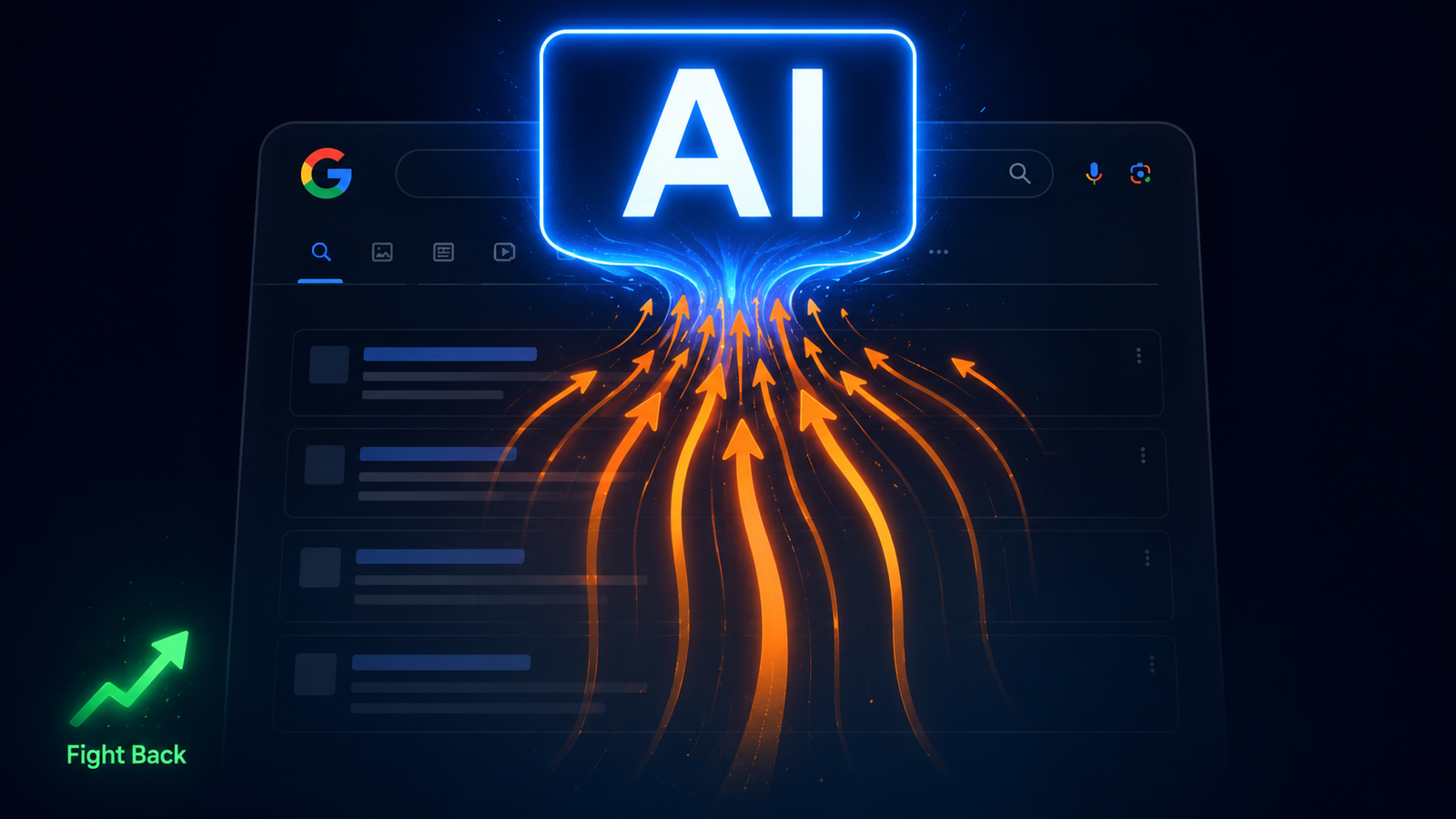
Google AI Overviews now appear on 48% of all search queries as of March 2026. When an AI Overview appears on a results page, organic click-through rate drops between 34% and 61%. For many website owners, this is not a future risk — it is already happening to their traffic today.
Picture this. You have spent months writing a thorough, well-researched article on a topic your audience searches for. It earned a solid position on page one of Google. Traffic flowed in steadily. Then, gradually, the numbers started declining. The ranking did not change. The content did not change. But the clicks dried up.
The culprit, almost certainly, is a feature most website owners did not ask for and cannot turn off: Google AI Overviews. They sit above your result. They answer the question your page was written to answer. And according to research tracking millions of search queries, they are making users dramatically less likely to click through to the actual sources.
This is not a temporary glitch. It is a fundamental change to how Google delivers information — and it is accelerating. But here is the thing that the panic-driven headlines miss: understanding how AI Overviews work also reveals exactly how to respond. There are websites gaining traffic right now despite AIO, and the strategy they are using is learnable. This article covers what is actually happening, who is losing and why, and eight proven tactics to stop the bleeding and start competing in this new search environment.
What Are Google AI Overviews, Exactly?
Google AI Overviews — originally launched as Search Generative Experience (SGE) in 2023 — are AI-generated summary boxes that appear at the very top of Google search results. They are built by Google's Gemini AI, which reads and synthesises content from multiple web pages and delivers a direct answer to the user's query, typically in two to four paragraphs, with a small selection of cited sources shown as links beneath the summary.
The mechanism is important to understand. Google is not writing original content. It is pulling passages from existing web pages — including, quite possibly, yours — synthesising them into a unified answer, and delivering that answer to the user before they ever see the organic results list. The user gets what they came for without clicking anything. The websites whose content was used to build that answer get no traffic.
AI Overviews now appear on 48% of all Google searches as of March 2026, up 58% year over year. A feature that barely existed in 2023 now shapes how nearly half of all Google searches are experienced.
The Real Numbers — How Bad Is the Traffic Loss?
The data from multiple large-scale studies paints a consistent and sobering picture. This is not anecdotal — it is measured across tens of millions of actual search impressions.
Seer Interactive's September 2025 study — tracking 3,119 informational queries across 25.1 million organic impressions — found that organic CTR collapsed from 1.76% to 0.61% for queries with AI Overviews present. That is a 65% decline. Even at the top-ranking position, the presence of an AI Overview above your result dramatically reduces the likelihood that a user will scroll down and click.
The aggregate picture from Pew Research's analysis of 68,000 real queries found that when an AI Overview appeared, only 8% of users clicked any organic result — compared to 15% for the same type of query without an AI Overview. That 7 percentage point difference sounds small in isolation, but across an entire site's traffic, it is half the clicks disappearing.
"Ranking #1 on Google no longer guarantees clicks. Being cited inside AI Overviews is the new visibility currency."
— eseospace.com, How Google AI Overviews Impact SEO in 2026These are not edge cases. HubSpot reportedly lost 70–80% of its organic traffic in 2024-2025, partly attributed to AI Overviews dominating its informational keyword targets. News and media publishers saw similar patterns. The common thread: sites built around answering simple, direct questions — the exact type of content AI Overviews are designed to synthesise — were hit first and hardest.
Which Types of Content Get Hit Hardest
AI Overviews do not treat all queries equally. Understanding which content types trigger them — and at what rate — is the first step to building a defensive strategy. The data here is precise and actionable.
| Query Type | AIO Trigger Rate | Impact Level | Examples |
|---|---|---|---|
| Comparison (X vs Y) | 95.4% | Highest | WordPress vs Wix, LED vs OLED |
| Question format | 57.9% | Very High | "How does X work?", "What is Y?" |
| Long-tail (8+ words) | 7× more likely | Very High | Specific how-to queries |
| Informational general | 36% | High | Definitions, explanations |
| Commercial intent | 8% | Low-Medium | "Best X for Y", reviews |
| Transactional | 5% | Low | "Buy X", "X price", "X near me" |
Definition & "What Is" content
"What is page authority", "what is a bounce rate" — AI answers these completely, leaving nothing to click for.
Basic How-To guides
"How to add a sitemap to Google" — 4-step answers fit perfectly in an AI Overview. Your 2,000-word guide becomes unnecessary.
Listicles and roundups
"Best free SEO tools" — AI can synthesise top picks. But nuanced, opinion-driven recommendations are harder to replicate.
Commercial & transactional
"Buy SEO audit tool", "domain authority checker free" — only 5-8% trigger AIO. User intent requires clicking to actually get the product or tool.
The single clearest pattern: AI Overviews are built for informational, question-based content. If your site exists primarily to answer direct questions — definitions, comparisons, how-to instructions — you are facing the highest exposure. If your site exists to provide tools, products, services, or deeply opinionated, experience-driven content, your exposure is significantly lower.
The Silver Lining — Why Being Cited Changes Everything
Here is the data point that transforms this from a crisis into a strategy problem: brands cited inside AI Overviews perform dramatically better than brands that are simply present in the organic results beneath them.
Per Seer Interactive's 2026 research across 53 brands and 49,353 queries: brands cited inside AI Overviews earn 120% more organic clicks per impression than non-cited brands on the same query. On the same search results page, the difference between being cited and not cited is nearly double the clicks. Being cited also drives 91% higher paid CTR — the brand halo effect extends beyond the organic results into paid search on the same query.
Put simply: AI Overviews have not eliminated traffic from Google. They have redistributed it. A smaller number of brands are capturing a larger share of the remaining clicks, and those brands are the ones being cited as sources inside the AI-generated answer. The goal of your SEO strategy is no longer just "rank on page one." It is "become a cited source in the AI Overview."
That shift in goal completely changes the tactics. Which brings us to the part that actually matters.
8 Tactics to Fight Back Against Google AI Overviews
These are not theoretical suggestions. They are the patterns emerging from the research data on what is actually getting sites cited, what is protecting traffic, and what is recovering rankings that the AIO rollout displaced.
Google's AI does not cite entire pages. It cites specific passages — what researchers call "answer units." According to analysis of how AIO selects its sources, the most-cited passages are 134 to 167 words long, begin with a direct answer to the question, and are self-contained enough to be understood without the surrounding context. This is the single most actionable structural change you can make to your content.
Rewrite your H2 and H3 sections so each one begins with a direct, concise answer to the question implied by the heading — then expands with detail. This structure serves both human readers and the AI extraction pipeline.
In this section, we're going to discuss what page authority actually is. There are many factors that go into this and it's quite a complex topic, but we'll try to break it down in a way that's easy to understand for beginners...
Page Authority (PA) is a score from 1 to 100 developed by Moz that predicts how likely a specific URL is to rank in search results. Higher scores indicate stronger ranking potential. PA is calculated using backlink data, link quality, and domain-level signals — and unlike Domain Authority, which measures the whole site, PA measures a single page. A score above 40 is generally considered competitive for most niches.
Question-format queries trigger AI Overviews 57.9% of the time — but they also represent the exact queries that FAQ schema was designed for. Adding a structured FAQ section to your most important pages does two things simultaneously: it gives Google's AI clearly labelled question-and-answer units to extract, and it improves your eligibility for featured snippets on queries where AI Overviews do not appear.
Implement FAQ schema using JSON-LD structured data. Each FAQ item should have a concise question (matching how users actually search) and an answer of 50 to 150 words — long enough to be informative, short enough to be extractable. Make the answers factual, specific, and useful without requiring the user to read the full article to understand them.
The data on AI Overview trigger rates by intent is the most actionable finding in the research: transactional queries trigger AI Overviews only 5% of the time, and commercial queries only 8% — compared to 36% for informational queries and 95.4% for comparison queries. This is not a coincidence. Google has a financial incentive to keep commercial and transactional search traffic flowing to organic results, because that traffic connects advertisers with buyers.
Practically, this means two adjustments to your content strategy:
- Reframe informational content with commercial intent modifiers. Instead of "what is domain authority," target "domain authority checker free" or "how to improve domain authority fast." The same audience, but the commercial framing is less likely to trigger an AI Overview.
- Create bottom-of-funnel content. Comparisons like "X vs Y for small businesses," "best X under $Y," and "X alternatives" serve users who are evaluating options, not just gathering information — lower AIO trigger rates and higher conversion intent.
Google's AI can synthesise information that already exists across the web. It cannot synthesise original data that only exists on your site. This is the clearest competitive moat available in the AIO era: content that is the primary source rather than a restatement of existing knowledge.
Original research means surveys, data analysis, experiments, or case studies that produce findings no other site has published. When your article is the primary source of a statistic or finding, AI Overviews are far more likely to cite you specifically — because there is no alternative source for that data. This also drives natural backlinks from other sites citing your research.
This does not require a dedicated research department. A survey of 50 people in your audience, an analysis of your own tools' data patterns, a documented experiment you ran on your own site — all of these produce original data that gets cited where aggregated summaries do not.
Research into which pages get cited in AI Overviews consistently shows that E-E-A-T — Experience, Expertise, Authoritativeness, and Trust — functions as a binary pass/fail gate before the AI even evaluates your content for citation. Only 38% of AIO-cited pages now rank in the traditional organic top ten, which confirms that authority and trust signals matter independently of traditional ranking position.
The specific signals that improve E-E-A-T for AIO citation:
- Author credentials — Named authors with bios, published track records, and social proof. Anonymous content is deprioritised as a citation source.
- External mentions — Being referenced by other sites, appearing in industry discussions, and having backlinks from authoritative domains. Domain Authority is the #1 predictor of AI citations according to SE Ranking's 2025 research.
- Review platform presence — Sites with profiles on Trustpilot, G2, Capterra, or equivalent platforms have 3× higher AI citation chances. These third-party validations signal trustworthiness.
- Content freshness — Pages not updated quarterly are 3× more likely to lose AI citations. Stale content signals reduced relevance.
Not all queries in your niche trigger AI Overviews. Because transactional and commercial queries have 5-8% trigger rates versus 36-95% for informational queries, every keyword in your strategy now has a different risk profile depending on intent. The keywords that do not trigger AI Overviews are — counterintuitively — more valuable than they were before, because they still deliver the full pre-AIO click volume while being ignored by the AIO redistribution effect.
Audit your current keyword set and classify each one by AIO trigger likelihood:
- High-risk: "what is X," "how does X work," "X vs Y" comparisons, question-format queries
- Medium-risk: general "how to" guides, listicles, "best" roundups
- Low-risk: tool-name searches, "free X checker," "X near me," brand-modified queries, "buy X," "download X"
Prioritise creating new content around low-risk keyword clusters. For high-risk keywords you already rank for, apply the answer-block restructuring from Tactic 1 to compete for citation — these pages are already targets whether you optimise them or not.
A page that loads slowly, has content in JavaScript that Googlebot cannot render on first pass, or has broken internal links disrupting crawl paths — all of these reduce the extractability of your content for AI Overviews. The AI can only cite what Google can read. If your content is technically inaccessible, no amount of structural optimisation will help.
Three technical checks every site owner should run immediately:
- Check page speed: Google's own research confirms that pages loading above 3 seconds see significantly reduced crawl frequency — and reduced crawl frequency means slower AIO citation candidacy updates. Use the PageSpeed Insights Checker to identify and prioritise speed issues.
- Check for broken internal links: Broken links waste crawl budget and prevent Googlebot from reaching pages that should be citation candidates. Run the Broken Links Finder on your key pages.
- Verify your meta tags are correct: A
noindexmeta robots tag on a page you want cited is a silent killer. Check every key page with the Meta Tags Analyzer.
Here is the data point that reframes the entire AI Overviews challenge: branded queries with AI Overviews actually see an 18% CTR increase — not a decrease. When someone searches specifically for your brand name, the AI Overview reinforces your presence rather than replacing your traffic. This is because branded intent signals that the user specifically wants your site, not just any answer to a question.
Every effort that builds genuine brand recognition — appearing in industry publications, being mentioned in podcasts and YouTube videos, earning backlinks, having a recognisable presence in your niche — is also an AIO defence. Users who know your name will search for it specifically, and that query type is among the most protected from AIO traffic disruption.
Additionally, Digital Applied's 2026 research found that branded queries with AIOs see CTR increases, while non-branded informational queries see the steepest declines. The strategy implication: invest in brand-building activities alongside content SEO. In the AIO era, being a recognisable name in your niche is a traffic strategy, not just a marketing exercise.
What Not to Do — Common Mistakes to Avoid
Setting the data-nosnippet attribute on your content to block AI from reading it sounds like a defence but it is actually counterproductive. It prevents your content from being extracted for AI Overviews, yes — but it also removes your eligibility for featured snippets, reduces how well Google understands your pages, and can suppress traditional ranking signals. The correct strategy is to optimise for citation, not to block extraction.
A few other approaches that look logical but hurt more than they help:
- Abandoning informational content entirely. Informational content still builds topical authority, earns backlinks, and creates the surface area for citation. Cutting it removes you from the AIO ecosystem completely — you cannot be cited if you do not have content on the topic.
- Chasing traffic metrics instead of citation metrics. Raw click volume is no longer the right primary metric for informational content in the AIO era. Citation frequency, brand mention volume, and engagement rate per visit tell a more accurate story of whether your content strategy is working.
- Treating this as a temporary problem. Google's Search revenue grew 19% year over year in Q1 2026 despite AIO rollout. AI Overviews are expanding, not contracting. Strategies built around waiting for things to revert are not strategies.
Your Quick-Start Checklist
If you want to start today, these are the highest-leverage actions in order of impact and implementation speed:
- Pick your three highest-traffic informational pages and rewrite the first paragraph of each H2 section as a direct, 50-to-100-word answer block
- Add FAQ schema (JSON-LD) to each of those pages, covering the 4-6 most common questions on the topic
- Check every key page with the Google Index Checker — ensure none are unintentionally noindexed
- Run the Broken Links Finder on your top pages and fix every broken internal link
- Check your PageSpeed Insights score and fix anything below 70 — slow load time reduces crawl frequency
- Audit your next 10 planned content topics and reclassify each as informational (high AIO risk) or commercial/transactional (low AIO risk)
- Add author bios with credentials to every key article page — E-E-A-T signalling for citation candidacy
- Verify your meta description is set on every important page using the Meta Tags Analyzer
The Bigger Picture — This Is Evolution, Not Extinction
It is tempting to frame AI Overviews as the end of SEO. That reading is too simple. Google Search queries hit an all-time high in Q1 2026. Google Search revenue grew 19% year over year. Users are not abandoning Google — they are using it differently, and the ones who reach your website are increasingly doing so with more specific, commercial intent behind their queries.
The SEO strategies that built traffic in 2018 — high-volume informational articles targeting broad definition queries — are the specific strategies most disrupted by AIO. That is not the end of SEO. It is the end of a particular flavour of SEO that was already showing signs of diminishing returns before AI Overviews arrived.
The strategies that work in the AIO era are not fundamentally different from good content strategy: produce genuinely authoritative content, build real brand recognition, solve specific problems for specific audiences, and ensure your site is technically clean enough for Google to understand and trust it. What has changed is the execution details — answer blocks instead of meandering introductions, schema markup instead of unstructured text, commercial intent keywords instead of definition queries.
The sites adapting fastest are not the largest ones — they are the ones that recognised the shift early and made deliberate adjustments. The data shows clearly that AIO has created a new tier of winners: sites that earn citations. That tier is not closed. The eight tactics above are the entry point.
The Bottom Line
Google AI Overviews are real, they are expanding, and the traffic impact is measurable across millions of queries. But the panic-driven response — abandoning informational content, blocking AI from reading your site, or simply waiting for things to change back — is worse than the problem itself.
The winning response is a targeted upgrade to how you structure content, which keywords you prioritise, how you build authority signals, and how consistently you maintain technical site health. Sites that earn AIO citations get 120% more organic clicks than non-cited brands on the same queries. The redistribution is happening whether you optimise for it or not. The question is which side of that redistribution you end up on.
Start with the checklist. Pick one tactic to implement this week. The changes compound over time, and the earlier you begin, the more citations you accrue before your competitors catch up to this new reality.
Start With a Technical Health Check
Before optimising for AI Overviews, make sure Google can fully read and trust your site. Run these free checks first.